
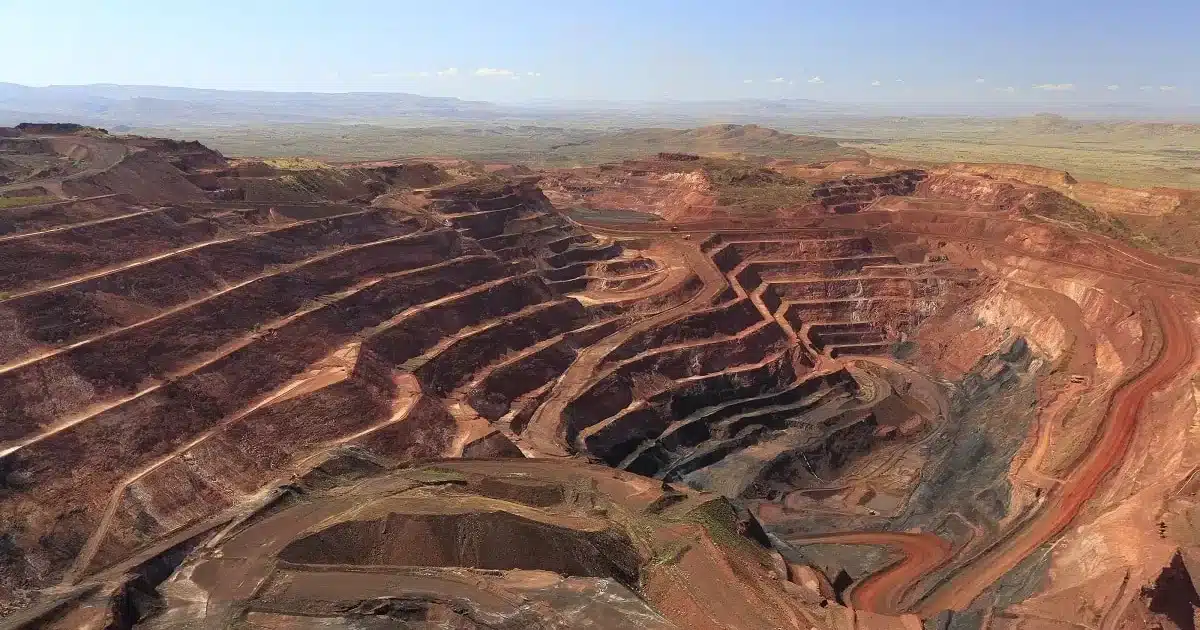
Australia's Pilbara region has just been confirmed as home to the world's largest iron ore deposit, a colossal find estimated at 55 billion metric tons with a value approaching $6 trillion. The discovery rewrites both economic geography and geological theory, challenging decades of scientific consensus about how and when iron deposits form.
The Hamersley Province in Western Australia has long been known as a major source of iron ore, but nothing in the historical record prepared scientists or markets for a find of this magnitude. Geologists using advanced survey methods, cutting-edge imaging techniques, and isotopic dating analysis confirmed the deposit's extraordinary scale, along with a detail that immediately unsettled the scientific community: the formation is approximately 1.4 billion years old, far younger than the accepted window for major iron mineralization events.
That accepted window, a consensus built over generations of geological research, placed the formation of significant iron deposits between 2.5 and 1.8 billion years ago. This discovery lands well outside that range, and the implications stretch far beyond a single mine site.
The geological surprise hidden beneath Pilbara
For decades, the Pilbara region was already among the most productive mining territories on Earth. But the sheer scale of what surveys have now confirmed transforms the conversation entirely. The deposit carries an iron content exceeding 60%, a grade that makes it commercially exceptional by any standard. High-grade ore of this kind requires less processing, produces less waste, and delivers stronger margins across the entire supply chain.
A timeline that breaks the rules
The dating of this formation at roughly 1.4 billion years forces a fundamental rethink. Previous models assumed that the great banded iron formations, those massive accumulations tied to ancient atmospheric and oceanic chemistry, had essentially stopped forming by 1.8 billion years ago. The Hamersley find suggests that iron-rich mineralization continued far longer than previously understood, likely connected to the cycles of ancient supercontinents. Researchers are now working to develop new evaluative frameworks that can account for this extended geological window.
What isotopic analysis revealed
The methods used to date and characterize the deposit were not conventional. Teams deployed isotopic analysis alongside high-resolution imaging to map the deposit's internal structure and confirm its age. These same techniques are now pointing toward the possibility that other ancient geological regions, currently underexplored, might harbor similarly large concentrations of mineral wealth. The scientific community is treating this as a prompt to look harder at formations previously dismissed as unlikely candidates.
estimated value of the Hamersley iron ore deposit
Australia's position in global steel production is being redefined
The economic consequences of this discovery are already being mapped by investors, industrial planners, and governments. Australia was already a dominant supplier of iron ore to global markets, particularly to steelmakers in Asia. But 55 billion metric tons of high-grade ore consolidates that position in a way that reshapes the entire competitive landscape of the steel supply chain.
Infrastructure and export systems under review
Australian policymakers are actively considering upgrades to infrastructure and export systems to handle anticipated increases in production volume. The Pilbara already has rail networks and port facilities built around large-scale ore export, but a deposit of this size demands a different order of investment. Regional economic growth is a near-certainty: job creation, expansion of service industries, and deeper investment in transport networks are all expected to follow as development plans solidify.
Downstream effects on steel-dependent industries
Steel is the material backbone of construction, automotive manufacturing, high-tech fabrication, and infrastructure development worldwide. A stable, abundant, high-grade source of iron ore has the potential to moderate input costs across all of these sectors. Countries that currently rely on less reliable or more expensive sources of iron could shift their sourcing strategies significantly, reducing supply chain vulnerability. International stakeholders, from Asian steelmakers to European manufacturers, are already reassessing their procurement approaches in light of what Hamersley now represents.
Iron ore with a grade exceeding 60% iron content is classified as high-grade and commands premium pricing on global markets. Most commercially mined ore falls in the 55–65% range, making the Hamersley deposit’s confirmed grade particularly significant for processing efficiency.
The scientific and industrial response
Researchers are not treating this as a closed chapter. Analysis of the deposit's data is ongoing, and the broader geological question, of how and why iron-rich mineralization persisted far beyond the previously accepted timeline, is now an active area of inquiry. Just as scientists pushing the boundaries of what seemed biologically possible have generated unexpected results, as seen in efforts to reconstruct ancient genetic material from extinct species, geologists are now confronting the limits of their own models and finding them inadequate.
The industrial response is moving on a parallel track. Mining companies are evaluating extraction methodologies that can handle a deposit of this scale without triggering the environmental and regulatory problems that have historically accompanied large-scale mineral development. Sustainable extraction and processing technologies are under accelerated development, and there is growing discussion of international collaboration to bring the most ecologically responsible approaches to bear on what will inevitably become one of the most scrutinized mining operations in history.
Regulatory and ethical dimensions
Anticipated discussions around ethical sourcing, transparent mining practices, and mutually beneficial trade agreements are already being flagged by policymakers and advocacy groups. A deposit worth $6 trillion does not develop in a regulatory vacuum. New safety protocols and environmental regulations are expected to accompany any large-scale extraction program, and the pressure to get those frameworks right, before major operations begin, is considerable. The scale of the economic opportunity makes the governance challenge equally large. Getting both right simultaneously will define how this discovery is ultimately judged, not just by markets, but by the communities and ecosystems that surround the Hamersley Province.
The Pilbara find is a reminder that the Earth continues to surprise even the most sophisticated observers. And much like unexpected discoveries in other fields, where simple interventions produce results that seem improbable until they are tested, the most consequential findings often emerge from places and timelines that conventional wisdom had already written off.