
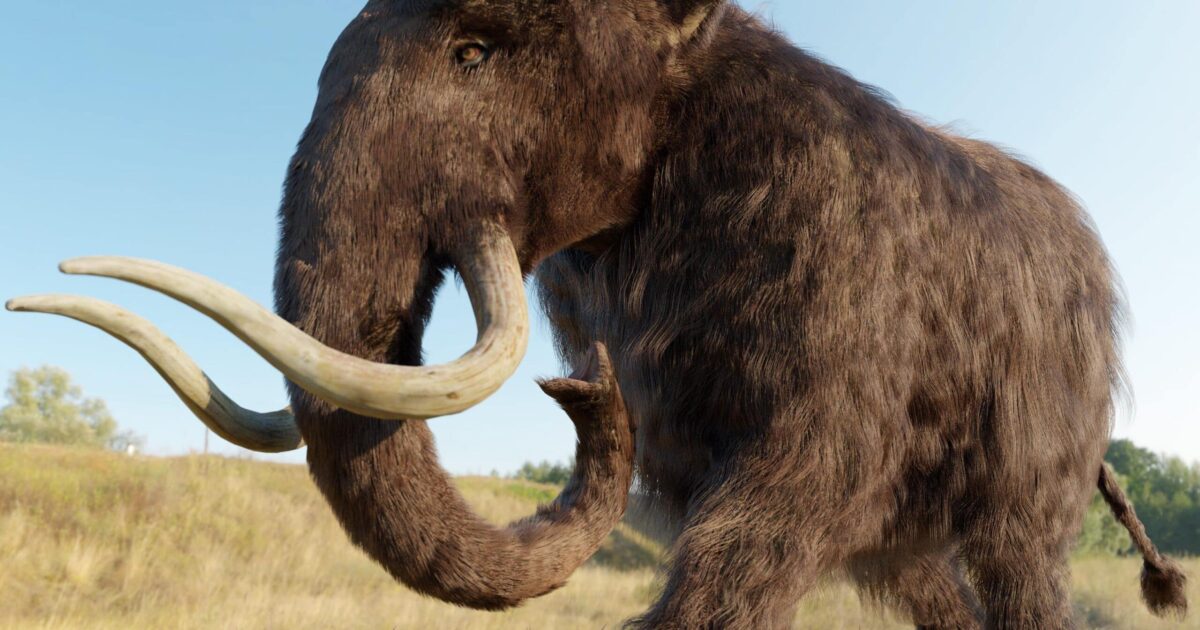
Colossal Biosciences has engineered genetically modified woolly mice with golden, dense fur and thick fat layers, using CRISPR technology to replicate mammoth traits in living lab animals. The goal: bring the woolly mammoth back to life by 2028, when the first mammoth-like calves could be born. In an attempt to bring mammoths back to life, scientists have created a strange creature — and this is only the beginning.
The images speak for themselves. Where ordinary lab mice sport short, sleek coats, these animals look almost unrecognizable: shaggy, golden-furred, visibly stockier. What Colossal Biosciences researchers have produced is not a mammoth, not even close. But it is proof that the biological building blocks of one of Earth’s most iconic extinct creatures can be transferred, gene by gene, into a living mammal.
This is science moving at a pace that evolution never could.
CRISPR rewrites millions of years of evolution
The woolly mammoth disappeared roughly 10,000 years ago, but its DNA did not vanish entirely. By analyzing ancient genetic material alongside the genome of its closest living relative, the Asian elephant, researchers at Colossal Biosciences identified thousands of genes through comparative genomics. From that vast pool, they isolated dozens of genes directly linked to hair density and fat metabolism — two of the most critical adaptations for surviving Arctic conditions.
How CRISPR edits mammoth traits into modern animals
CRISPR does not guess. The technology allows scientists to target specific segments of DNA with surgical precision: cutting out existing sequences, inserting desired ones, and effectively swapping a mouse’s native gene for its mammoth equivalent. The result, in this case, is a mouse that grows fur structurally similar to what a mammoth would have produced, along with a thicker subcutaneous fat layer suited to cold environments.
What took natural selection millions of years to refine, this team compressed into a laboratory timeline. The woolly mice are not a novelty experiment. They are a functional validation step, a living proof-of-concept that mammoth-specific genetic sequences can express themselves correctly in a warm-blooded mammal.
From mouse to elephant: the next phase of de-extinction
The logical escalation from mice to elephants is enormous, but Colossal Biosciences has mapped the path. The next stage involves refining the same gene-editing process in Asian elephant embryos, then implanting those embryos into surrogate elephants. Gestation periods for elephants run close to 22 months, meaning each attempt requires years of monitoring before any result can be evaluated.
The target remains fixed: 2028 as the year when the first mammoth-like calves could be born. Whether that timeline holds depends on how cleanly the edited embryos develop and how surrogates respond to the engineered pregnancies.
target year for the birth of the first mammoth-like calves
The ecological promise behind woolly mammoth de-extinction
Colossal Biosciences does not frame this project as a stunt. The scientific case for mammoth de-extinction rests on a serious ecological argument. Woolly mammoths were ecosystem engineers. Across vast grasslands and tundra, they shaped vegetation communities through grazing, trampling, and soil disruption. Their disappearance left a gap in those processes that no surviving species has filled.
Reintroducing mammoth-like animals into Arctic and sub-Arctic environments could, in theory, restore some of those lost functions: compressing snow to expose permafrost to colder air, promoting grassland growth over forest encroachment, and potentially contributing to carbon storage in degraded ecosystems. These are not speculative talking points. They reflect measurable ecological dynamics that researchers have been studying for decades in regions like Siberia.
Woolly mammoths historically shaped vast grassland ecosystems. Their reintroduction could influence permafrost preservation, carbon balance, and plant community composition across tundra regions.
Beyond ecosystems, the research generates tools. Advances in comparative genomics, embryo development, and gene expression in large mammals carry direct implications for veterinary medicine, disease modeling, and conservation strategies for currently endangered species.
The serious objections scientists cannot dismiss
Not everyone sees woolly mice and mammoth embryos as progress worth celebrating. Conservationists and ethicists have raised pointed objections to the entire de-extinction framework, and several of them deserve direct engagement rather than dismissal.
Redirecting resources away from living endangered species
The most grounded criticism targets funding and attention. The resources poured into mammoth de-extinction could instead support habitat protection, anti-poaching efforts, or captive breeding programs for species that still exist but are sliding toward extinction. Bringing back one iconic animal while dozens of living species disappear for lack of funding is a trade-off that many conservationists refuse to accept quietly.
Colossal Biosciences operates in a private funding environment, which means this is not strictly a zero-sum competition for government conservation budgets. But the broader argument about scientific priorities and public attention remains valid.
Unintended consequences in fragile ecosystems
The second major concern is harder to quantify but no less real. Introducing a large, genetically engineered herbivore into forests and tundra ecosystems that have evolved for thousands of years without mammoths could trigger cascading effects that no model fully anticipates. Vegetation communities, existing wildlife populations, soil microbiomes — all of these could respond in ways that are difficult to predict and harder to reverse.
Critics warn that de-extinction projects may divert critical conservation resources from living endangered species, while reintroduction into modern ecosystems carries unpredictable ecological risks.
The interdisciplinary team at Colossal Biosciences includes biologists, veterinarians, and ethicists — a sign that the organization acknowledges these tensions rather than ignoring them. But acknowledgment and resolution are different things, and the ethical debate around genetic de-extinction is far from settled.
What the woolly mice do confirm, regardless of where one stands on the ethics, is that the science works at a fundamental level. CRISPR-based gene editing can transfer functional mammoth traits into a living mammal. The fur is real. The fat layer is real. The expression of ancient genetic sequences in a modern body is real. Whether that capability should be pushed all the way to a living mammoth-like calf by 2028 is the question that biology alone cannot answer.